
Xbox Backwards Compatibility Program Returning for 25th Anniversary
Microsoft says its Xbox Backwards Compatibility Program is returning in some form later this year. The move comes as the company prepares to celebrate the Xbox brand’s 25th anniversary.
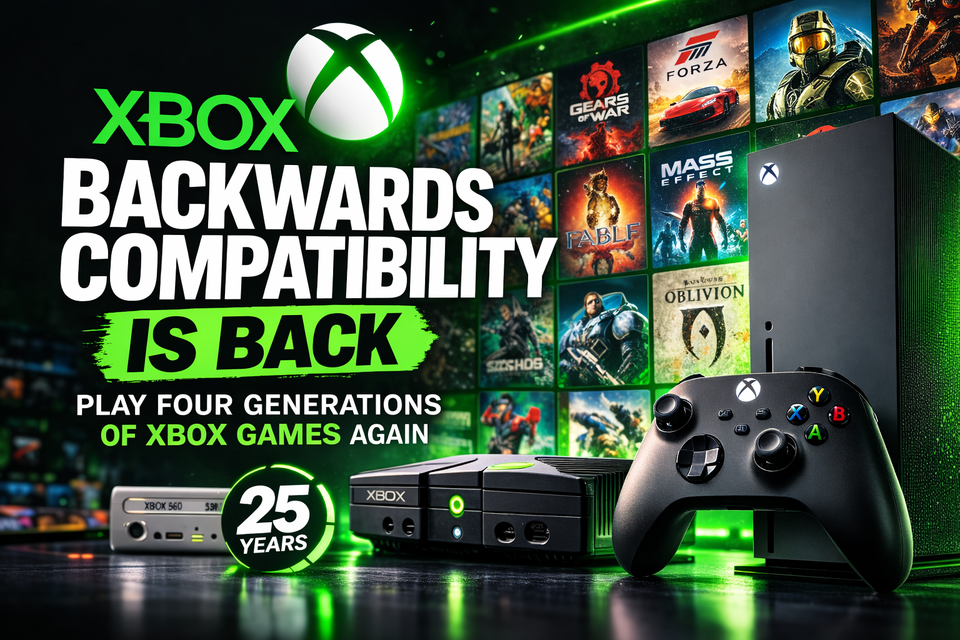
Xbox revives one of its most popular features
Microsoft confirmed at GDC 2026 that the Xbox Backwards Compatibility Program is coming back.
The initiative originally launched in 2015 and quickly became one of the most beloved features of the Xbox ecosystem. It allowed players to run games from the original Xbox and Xbox 360 on newer hardware.
The program effectively paused in 2021 after Microsoft said it had reached the limit of titles it could legally and technically bring forward.
Now the company says it is revisiting the effort.
Jason Ronald, VP of Next Generation at Xbox, said during the presentation that the team is still committed to preserving older games.
- Microsoft wants games from four generations of Xbox to remain playable
- New ways to access classic titles are coming later this year
- The timing aligns with Xbox’s 25th anniversary celebrations
Exact details are still unknown.
But the announcement alone is significant for longtime Xbox players who have pushed for the program’s return for years.
Why backward compatibility matters to Xbox players
Backward compatibility has been a defining strategy for Xbox over the past decade.
Instead of leaving older games behind with each new console generation, Microsoft built a system that lets newer Xbox hardware emulate older titles.
That system enabled several upgrades for classic games:
- Higher resolutions
- Faster load times
- Improved frame rates
- HDR support for some titles
Hundreds of Xbox 360 and original Xbox games were eventually added to the catalog.
For many players, that library helped differentiate Xbox consoles from competitors by turning each new generation into a continuation of the previous one.
The program’s 2021 pause
Microsoft halted new additions to the program in November 2021.
At the time, the company said it had already added every game it could secure.
The remaining titles faced barriers such as:
- Licensing issues with publishers
- Music rights
- Technical limitations with emulation
Microsoft said it had essentially exhausted the list of games it could legally bring forward.
That is why the new announcement is raising eyebrows.
If more games are coming, it suggests the company may have found new solutions for those old roadblocks.
New ways to play classic Xbox games
The phrase Microsoft used during the keynote stood out: “new ways to play some of the most iconic games from our past.”
That wording leaves the door open to several possibilities.
One major theory involves Windows PCs.
Microsoft also announced several initiatives aimed at blurring the line between Xbox and PC:
- A new Xbox mode for Windows 11
- A unified Game Development Kit (GDK) for both Xbox and PC
- Future hardware tied to the rumored Project Helix console platform
If Microsoft extends its backward compatibility tech to Windows, classic Xbox titles could potentially run directly on PC for the first time.
That would dramatically expand access beyond consoles.
It would also align with Microsoft’s broader strategy of turning Xbox into a platform ecosystem rather than a single device.
A milestone year for Xbox
The timing is not accidental.
The Xbox brand turns 25 later in 2026, and Microsoft appears to be using the anniversary to highlight the platform’s history.
Backward compatibility plays directly into that narrative.
Instead of abandoning older generations, Xbox is leaning into the idea that your gaming library should follow you forward.
And the company is signaling that commitment will continue with future hardware as well.
More details about the revived program are expected later this year.
Our take
Xbox has quietly built one of the strongest game preservation strategies in the industry.
The original backward compatibility program did more than add nostalgia. It showed players their libraries would not disappear every time a new console launched.
Microsoft is clearly pushing toward a future where Xbox games run across console, PC, handhelds, and cloud. If backward compatibility becomes part of that unified platform, classic Xbox titles could suddenly reach far more players than ever before.
The real question is whether new games will actually be added.
If Microsoft found a way around licensing and technical issues, the program could see a second life with long-requested classics finally arriving.
And if those games also come to PC, it could be one of the biggest expansions of Xbox’s ecosystem yet.